It is 7:45 in the morning. The bell has gone for assembly, and the front office is already three people deep.
A parent wants to know whether the fee payment window closes on Friday or Monday.
Three aunties at the gate are asking about the PTM date. They are asking the office because the notice went out on the school app, and nobody in that queue had opened the school app.
By 11 a.m., the same staff member has answered "when is the PTM" eleven times. She has also explained the holiday list twice, confirmed that the uniform shop is open on Saturday, and told four parents that the bus route change starts from the first of next month.
None of these are difficult questions. Every answer already exists — written down, checked, approved, and sent out.
The questions are not the problem
Count them at your own office tomorrow. There are about five.
Is the fee due this week? When is the PTM? Is there school on Saturday? What is coming in the test? And where do I pay, which uniform, which bus?
They arrive by phone, at the gate, on the class WhatsApp group, on the principal's personal number, and in the direct messages of whichever teacher looks most approachable. They arrive during admissions season and during exam week. They arrive at 9 p.m. on a Sunday, which is when a working parent finally sits down and thinks about school.
Your office does not answer these five questions all day because the school is badly run. It happens because the school is well run. There is a circular for everything.
That is the trap.
The information exists. It is just in the wrong place.
A circular is a publishing act. The school writes it, formats it, sends it, and considers the job done — reasonably, because the job was done.
The parent, meanwhile, is not reading. Not out of disrespect. The parent is on a bus, in a meeting, at a hospital, or in the kitchen, with one free hand and a phone carrying forty WhatsApp groups. When a question surfaces, a tired person does the fastest thing available: they ask a human being. WhatsApp is where their day already happens. The circular is where the school's information lives.
So the two never meet. The school publishes; the parent asks. The school publishes again, more urgently; the parent asks someone else. The office becomes the interface between a document and a person who will never open the document.
The cost is not only the eleven repetitions before lunch. It is the admissions coordinator who spends her morning on PTM dates instead of following up last week's open day enquiries. It is the class teacher answering fee questions at 10 p.m. It is three people giving three slightly different answers, and a parent who now trusts none of them.
Why the usual fix does not work
The standard response is to add people and channels. Another staff member on WhatsApp duty. Another PDF, this time with a cover note. Another group, this one labelled official, parents only.
Load shifts. It does not drop.
Each addition creates one more place the answer might be, and one more place a parent has to look. The office is not short of information or effort. It is short of a way for the answer to reach the place where the question is being asked.
And every one of these fixes assumes the parent will come to the school's channel. Most will not. The school has to go to theirs.
The question that stops arriving
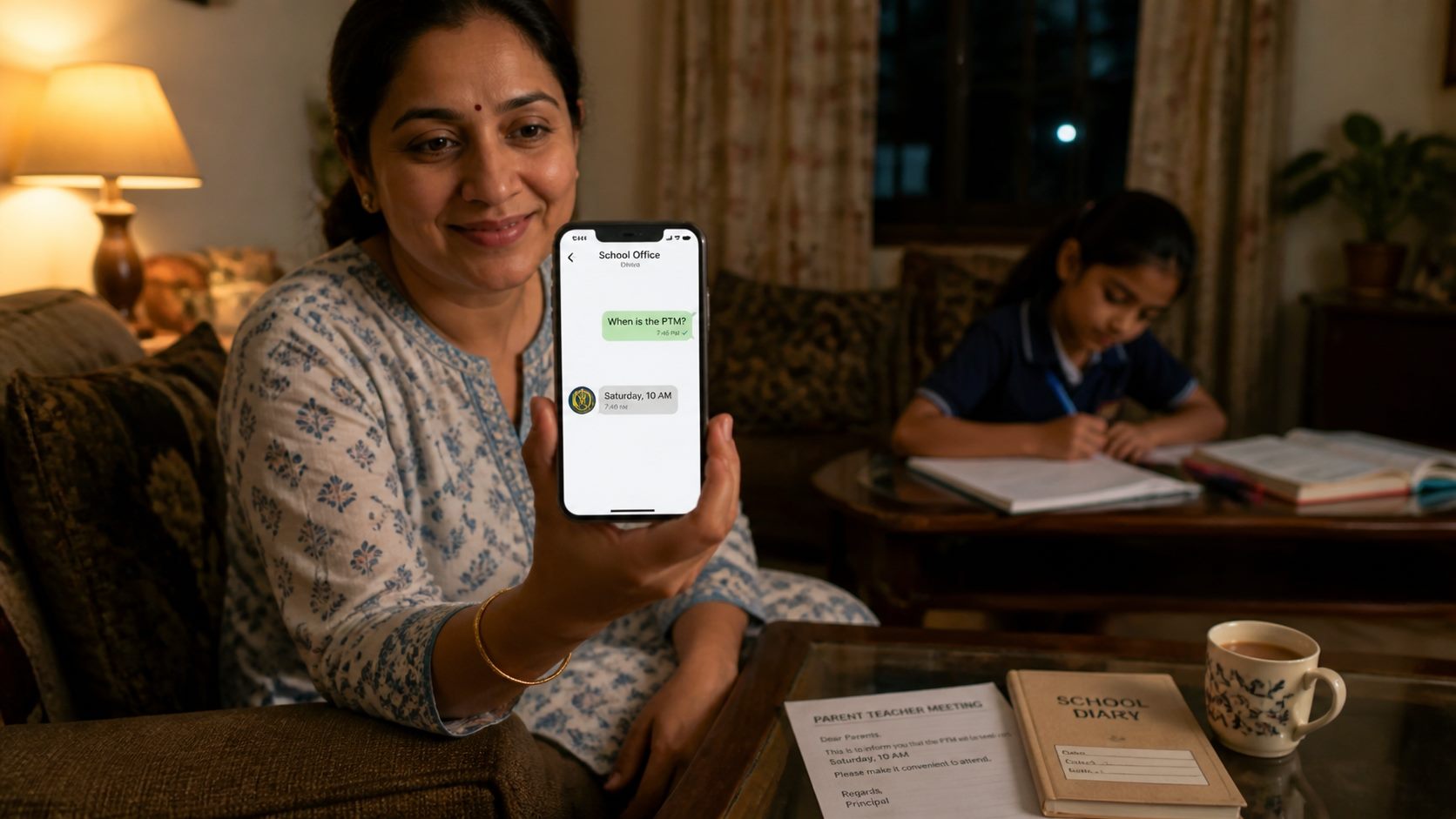
Here is the shift. The parent asks "when is the PTM" in the same WhatsApp window they already use for everything else. The school answers — in the school's own words, from the school's own circular, at 9 p.m.
The parent gets the date. They do not call the office in the morning. They do not message the class teacher. They do not stop at the gate to ask an aunty, who then asks the office.
The question was not answered faster. It stopped arriving.
That is the whole idea. It is why we call eKTextAI an admissions and communication engine rather than a messaging tool. It answers from what your school has already written and approved — the circular, the fee policy, the holiday list, the transport note. When it cannot answer from that material, it says so plainly rather than guessing, and some questions are handed to a member of your school's staff. When the school needs to send rather than reply — a fee deadline, an open day, an admission window — it sends that too.
The team behind eKTextAI has been building school software since 2009. This is the part that software was missing: the school's own voice, in the parent's own window, without a person repeating themselves all morning.
What the office gets back
The front office keeps its queue for the things that need a human. The parent who is upset. The fee case that needs a conversation, not a date. The grandparent who cannot manage a phone. The family deciding between two schools.
The coordinator gets her mornings for admissions follow-up.
The principal stops being the escalation route for a date that was published three times.
And the school gives one answer, in one voice, whether the parent asks at 8 a.m. or 11 p.m.
Fifteen minutes
If your office answered the same five questions this morning, that is the whole case. You can test it in a quarter of an hour.
Bring one circular. We will run it in a fifteen-minute demo, and you can judge whether the answers are the answers your school would give.
That bar is low on purpose. Everything else — the campaigns, the fee reminders, the admission follow-ups — only matters once that first thing is true.
Bring one circular.
We'll run it in a fifteen-minute demo, and you judge the answers.